
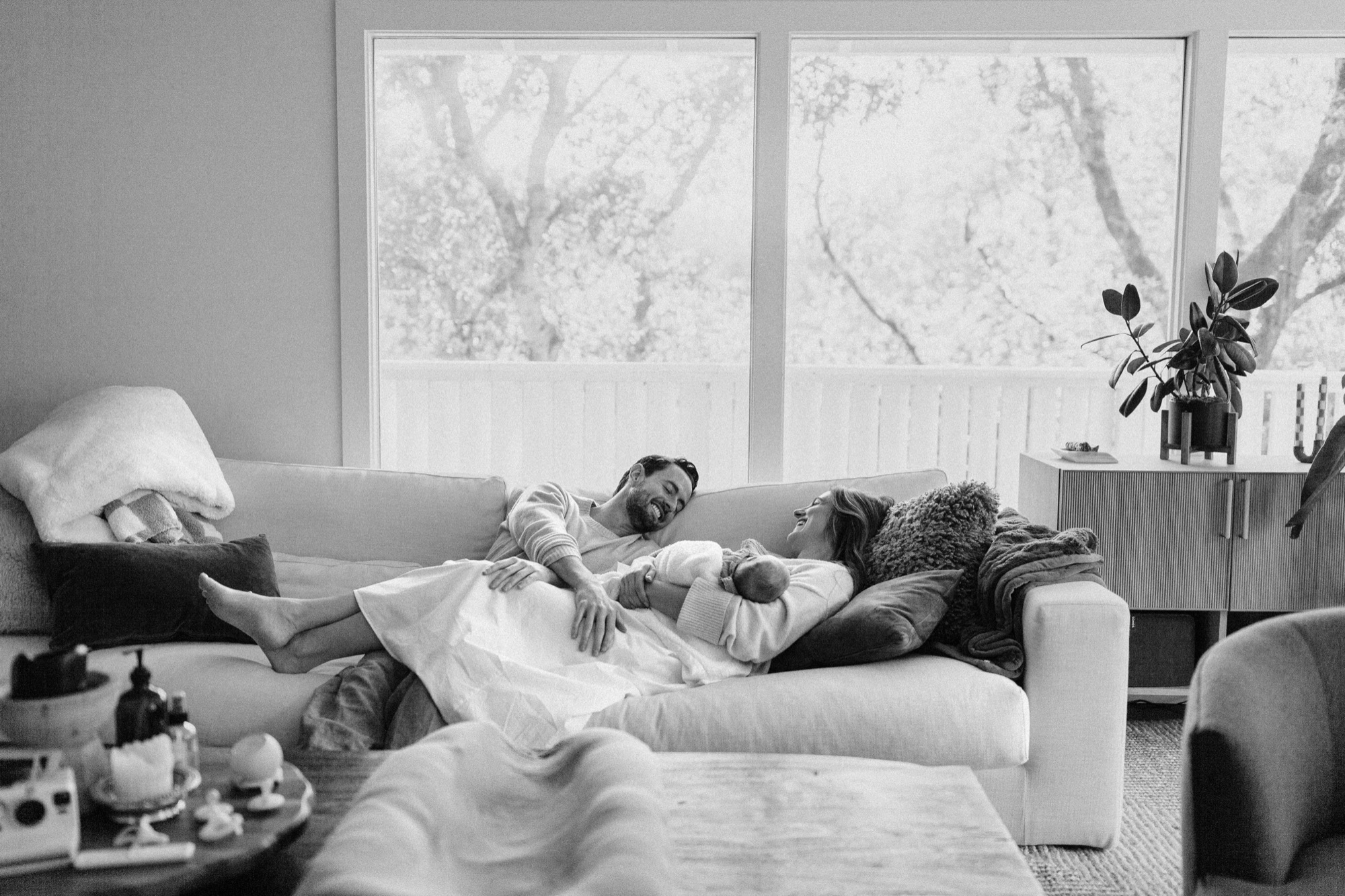
The question I get asked more than almost any other before a newborn session: What time of day is best?
The honest answer is: it depends on your home. Not your neighborhood, not the season: your specific home. The direction your living room faces, the size of your windows, whether you’re in the trees or on a hill with a view.
I’ve been photographing in-home newborn sessions in Marin County since 2018, in homes from Mill Valley to Tiburon to the flatlands of San Anselmo. What I’ve learned is that every home has its own light personality. Once you understand yours, scheduling your session around it becomes much more intuitive.
Here’s how I think about it.
First: Turn Off Your Indoor Lights
Before we get into window light, one thing that makes an enormous difference: turn off every lamp and overhead light in the rooms we’ll be shooting in.
Indoor lighting has a different color temperature than natural light. It photographs warmer, sometimes orange or yellow, and it competes with the tones that window light produces. When it mixes with daylight in a photo, it throws everything off. You’d never notice it with your eye, but the camera picks it up immediately.
Natural window light only. That’s where we start.
The Three Kinds of Light I Work With
Fill Light: my favorite
Fill light is soft, indirect light. It’s not the sun coming directly through your window. It’s the reflected light from the sky, the landscape, the building across the street. It comes from the direction of a window without being harsh.
It can feel almost too dim in person. In photos, it’s gorgeous: even, detailed, gentle. It has a quality close to studio lighting, but with the soul of a real home. When you see an in-home newborn photo where the light seems to wrap softly around the baby, that’s fill light.
Direct Light: emotive and dramatic
Direct light is the sun actually coming through the window (rays, a strong highlight on the subject, that particular warmth). Think of 5pm light pouring into a kitchen with dust floating in the air, when everything looks romantic and you don’t even care. That’s direct light.
I love working with it in small doses. Rays landing on a baby’s face, a strong sidelight on a nursing mom: these are images that carry heat and feeling.
What I avoid: an entire room flooded with direct sun. When the main light source is filling the whole space, it’s too bright and too harsh. It reads as squinty rather than soft. Rays of light streaming in? Beautiful. A south-facing room at noon on a sunny day? We plan around that.
Middle Light: the most common in Marin homes
Middle light is what you get in a south-facing home in the middle of a sunny day (broadly bright, the sun has circled the house and the whole room is lit, but not dramatically). Not too soft, not too intense. It’s the everyday light of a lot of Marin living rooms, and it photographs beautifully. Great for lifestyle and documentary moments.

How to Read Your Marin Home
Mill Valley
Mill Valley homes in the trees get a lot of fill light. The canopy filters and softens everything coming in. Less overall light, but that’s not a problem. A slightly darker room still photographs beautifully, and the quality of light that comes through redwoods has a softness you can’t manufacture.
Some Mill Valley homes sit on hillsides with bigger views and bigger windows. Those can get intense, direct light at certain hours. If your home is one of those, we’ll make sure we’re not shooting when the sun is flooding the main room. We want the rays, not the flood.
See what that fill light looks like in a real Mill Valley newborn session.
Tiburon
Tiburon bay-view homes are stunning, and they require a bit of scheduling care. A south-facing living room or master bedroom with a large bay-view window can get very direct, very intense light when the sun hits those windows head-on. For those rooms, fill light or middle light is what we’re after.
The fix is straightforward: we figure out what time the direct sun hits your main windows and schedule around it. Morning sessions in southeast-facing homes, late afternoon in southwest-facing ones. There’s always a window that works beautifully.
South-Facing Hillside Homes (San Anselmo, Fairfax, Mill Valley Hills, San Rafael Hills)
My own home in San Anselmo faces southwest. In the morning, it has calm, cool fill light. The sky is bright but the sun isn’t hitting the windows directly. By afternoon it’s getting brighter. And at golden hour, direct light comes in, but because we’re not facing directly west, it arrives at an angle.
That angled golden-hour light is one of my favorites to work with. I’ll use it as backlight, or put the subject right in it for warm, emotive detail shots where the highlight is strong and the shadows fall behind. It doesn’t work for every setup, but when it does, it’s beautiful.
For south-facing hillside homes generally: we want direct light coming in at a diagonal, landing on slivers of the room, not flooding the whole space. If your view-facing room gets a full wash of direct sun at a particular time, we schedule around it.
Craftsman Bungalows and Homes in the Flats
More flexibility here. Homes in the flatlands of San Anselmo, Fairfax, or San Rafael tend to get less intense direct light. The sun isn’t hitting them at the sharp angles hillside homes experience. You’ll generally have a wider range of times that work, and fill or middle light through most rooms throughout the day.
What I’m Looking for When I First Walk In
When I arrive at your home before we begin, here’s what I’m actually doing: I look at the light first. Then the scenes the light is landing on. Then the furniture within those scenes, specifically what’s near the windows.
I’ll turn off every indoor light. Then I’ll walk through the rooms you’ve been thinking about, and probably a few you haven’t, looking for where the light quality is best and how your family can be in it naturally.
I’m also looking with something I can only describe as my heart. The feeling I get when I walk into a room almost always directly correlates with the photograph I’ll take there. Sometimes the most beautiful light is in a room that would never occur to you.

How to Prep Your Home’s Light (It’s Simple)
Not much to do, honestly.
Make the rooms we’ll shoot in generally ready, not perfect, just not in the middle of reorganization when I arrive. Little things here and there? Keep them. They’re part of the story, and either I’ll incorporate them or retouch whatever’s distracting.
Turn off all indoor lighting. That’s the most important thing on this list.
A few nice extras, if you want them: music playing in the background helps create a mood and gives baby something to focus on. Aromatherapy. A few outfit options laid out for baby, and any special blankets. For the baby and for you.
That’s it. You don’t need to stage your home. I’m coming to photograph your actual life.
Curious what the light is like in your specific home, or want to talk through timing before you book? Get in touch and we can figure it out together. When you’re ready, you can book a newborn session here, or learn more about in-home newborn sessions in Marin County.